The working definitions
Read more
FF&E covers seating, tables, beds, casegoods, decorative lighting, art, mirrors, window treatments and accessories, along with equipment chosen as part of the room, such as televisions. These items are selected with the design, coordinated with the plans and installed to a furniture layout. For what FF&E includes and where it stops and construction begins, see the companion article, What Is FF&E.
OS&E covers the shorter-lived and consumable items an operator uses daily. In a hotel that means linens and towels, pillows, china, glassware and flatware, kitchen smallwares, housekeeping carts, guestroom supplies, uniforms and back-of-house tools. OS&E items are usually bought in larger quantities, replaced more often and chosen to match how the operator runs the property.
One room, two lists
Read more
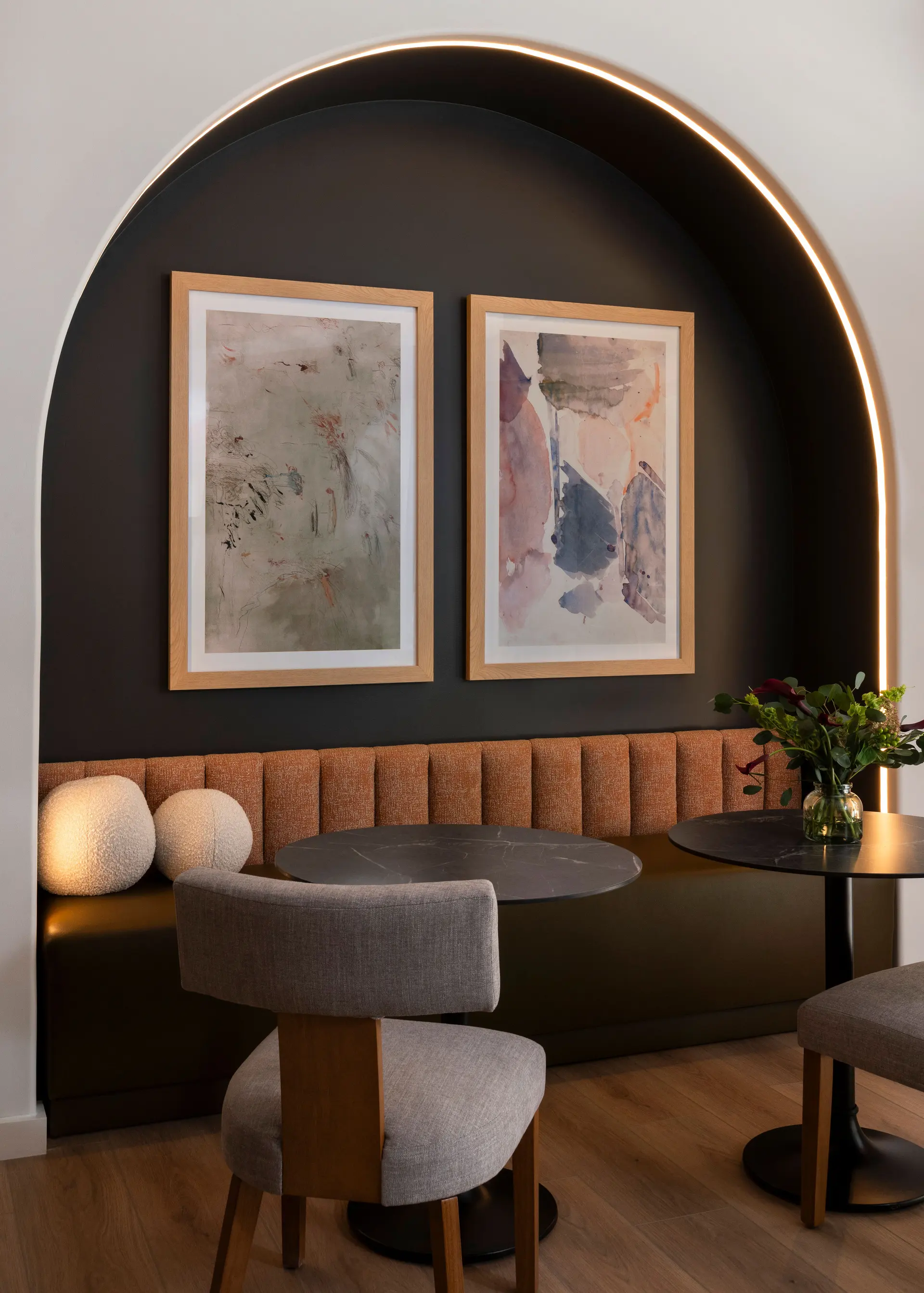
Walking through a single space shows how the split works. In a hotel restaurant, the chairs, banquettes, tables, pendants and art are FF&E; the plates, glassware, menu covers, table linens and service trays are OS&E. In a senior living dining room, the dining chairs and buffet furniture are FF&E; the dishware, serving equipment and activity supplies are OS&E. In an apartment clubroom, the sofas, game table and art are FF&E; the kitchen utensils for resident events and the cleaning supplies are OS&E.
A useful rule of thumb: if the item is placed once to a layout and stays, it is probably FF&E. If staff handle, wash, restock or move it during normal operation, it is probably OS&E.
Items that land in the gray zone
Read more
Some items do not fit neatly. Mattresses and box springs are typically FF&E in hotels, while the sheets and pillows on them are OS&E. Fitness equipment, in-room safes, minibars, televisions and outdoor umbrellas are assigned differently by different owners and brands. Tabletop decor can be either, depending on whether the designer specifies it as part of the room or the operator buys it as a supply.
There is no single correct answer for these items. What matters is that each one is assigned before purchasing starts, with a named buyer, an approval route, a receiving plan and a decision about who replaces it later. Brands often publish their own FF&E and OS&E lists, and on a branded hotel those lists control.
Who usually buys each
Read more
FF&E is usually bought by the design and procurement team, a purchasing agent or the owner, because the selections depend on layout, scale, finish and installation. OS&E is usually led by the operator or management company, because it reflects how the property will be staffed and run, and operators often have preferred suppliers and standards.
Some projects hand both lists to one purchasing agent. That can simplify vendor management, but the lists should still be tracked separately because the approvals, quantities, receiving and replacement owners differ. A simple responsibility matrix, with each item assigned to one buyer, prevents the common failure where each team assumes the other ordered it.
Budget and schedule differences
Read more
FF&E budgets are built room by room from furniture plans: quantities, quality tier, custom or stock, freight, warehousing and installation. They are often funded with the construction budget and the construction loan. OS&E budgets are built from operating standards and par levels, meaning the quantity of each supply the operator wants on hand. On a new hotel or senior living community, OS&E is often part of the pre-opening budget alongside hiring and training.
The schedules differ too. FF&E follows construction readiness: finished floors, elevator access, floor protection and room-by-room installation. OS&E follows opening preparation: stocking, staff training and mock service. FF&E has to be in place before OS&E can be put away, so the two should be planned together and delivered in order.
The split also matters to the accountants. Owners often treat FF&E as a capital asset depreciated over its useful life, while many OS&E items are expensed or held as operating inventory. The owner's accountant makes that call, but it is one more reason to settle the classification before invoices start arriving rather than sorting them afterward.
Why the split matters by property type
Read more
Hotels have the largest OS&E lists and the most brand rules, so the split is usually formal and written into the development budget. Senior living sits close behind: dining, activities and housekeeping all carry operating supplies, and in many independent and assisted living communities residents bring their own furniture to their apartments, so the owner's FF&E concentrates in common areas. Multi Family has the smallest OS&E scope, but it shows up in leasing offices, resident event kitchens, fitness rooms and any hospitality-style services, and it is the property type where the line is most often left undefined. Student housing sits in between: operators often furnish every bedroom, which makes the FF&E list long, while the OS&E list stays modest and centers on leasing, maintenance and shared-space supplies.
Closing the gaps before opening
Read more
The simplest control is a single scope schedule with four columns: construction, FF&E, OS&E and owner-provided. Review it before purchasing begins, then update it as decisions are made. Flag items that need power, blocking, storage, security or another trade.
On hotels, senior living and larger amenity programs, one working session with the design team, owner, operator and contractor, walking each space by use, resolves most of the gray-zone items in a single meeting. Record the outcome on the scope schedule the same day, because verbal agreements about who is buying a minibar or a set of patio umbrellas tend to be forgotten by the time purchase orders go out. The goal is to leave with every item assigned to one buyer.
By the Level Up Interiors team. Published 2026-10-10.